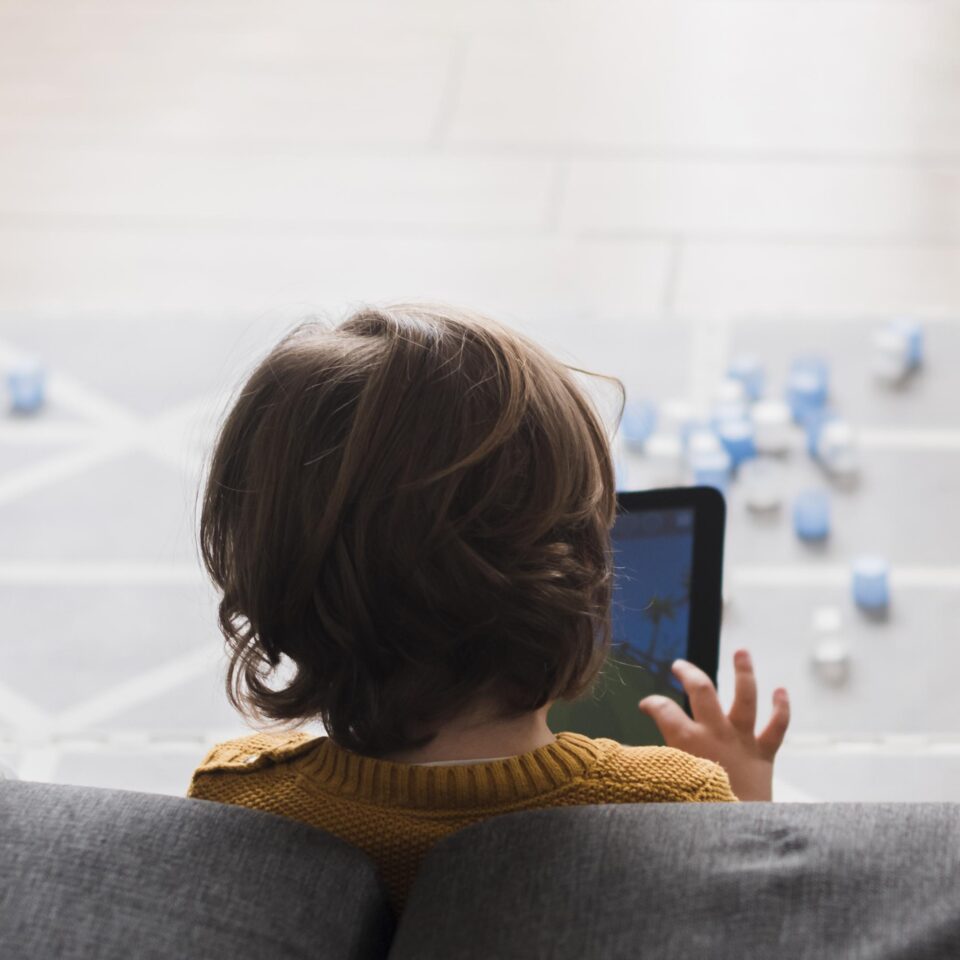

This summer, Pixar handed millions of families a mirror. In Toy Story 5, eight-year-old Bonnie is given a bright frog-shaped tablet called Lilypad, and slowly her beloved toys begin to gather dust. Woody and Buzz can wave, whistle and reason all they like but they are competing with a screen that was engineered to win. Director Andrew Stanton framed the film around a modern ache: what happens to childhood when nobody plays anymore? It’s a children’s film. It’s also a documentary about our living rooms.
We made Pala for the same question. Not to compete with screens on their terms, but to offer something screens can’t: a moment of presence you can feel on your wrist. And we’d like to introduce a small idea we think families and teachers might grow to love. We call it Pala Time.
The cost of screen time
None of us needs a study to notice it. The glazed look. The flare of frustration when a device is put away. The way a child who was calm ten minutes ago is suddenly a coiled spring. But the research has caught up with what parents already sense in their bones.
One of the largest efforts to understand this, the Adolescent Brain Cognitive Development study, which followed close to ten thousand children in the United States with repeated brain scans found that heavier screen use in childhood was associated with measurable differences in the regions that govern attention, memory and impulse control. Researchers are careful, and so are we: association is not proof, and the effects were modest. But children with more screen time early on tended to show more attention difficulties two years later. The pattern was there.
Others have described why this might happen in a way that feels intuitive. Screens are bright, fast and endlessly rewarding. As one group of researchers at Children and Screens puts it, a developing brain that spends its hours inside that heightened world comes to expect that world. And the ordinary, slower rooms of real life, a classroom, a garden, a conversation, start to feel harder to focus in by comparison. The problem was not a single video. It’s the calibration. We are quietly teaching young nervous systems that life should arrive at the speed of a feed.
And here is the part that unsettles us most, because it’s the part we can actually do something about. It isn’t only attention that suffers. It’s the ability to feel a big feeling and find the way back down.
The skill we forgot to teach
Most of us were never taught how to regulate ourselves. We were told to calm down which, as any child could tell you, is not the same as being shown how. We arrive at adulthood improvising, and then we raise children with the same missing instruction.
Yet the tool has been sitting inside us the whole time. The breath.
When a child is overwhelmed, their body tips into a stress response: heart quickens, breathing turns shallow, and the thinking part of the brain becomes harder to reach. Slow, deliberate breathing does something remarkable in the other direction. It gently invites the body’s own calming system, the parasympathetic branch, carried on the vagus nerve back online. This isn’t folklore. In primary schools, researchers have trained children aged seven to eleven to breathe at around six slow breaths a minute, and watched their heart-rate variability, a physical marker of self-regulation, rise in a meaningful way. Another study found that just a few guided deep breaths could measurably lower the average arousal of a whole classroom even when not every child fully joined in.
Breathing, in other words, is a life-long skill that is quiet, free, always available, and almost never taught. A child who learns it early carries it into every hard moment for the rest of their life. That feels, to us, like one of the most valuable things a parent or a teacher could ever pass on.
The trouble is that “just breathe” is abstract. Children can’t see a breath. They can’t hold it. And so the instruction slides off. What if breathing had a shape? Something to follow, to breathe with, that asks for nothing but a wrist and a minute?
Introducing Pala Time
Pala Time is simple. It’s a three to five minutes when the screens go dark and you Pala instead.
Pala is a screenless band that gives one thing: a soft, rhythmic pulse against the skin, a tide to breathe along with. There is no app to open, no notification to chase, no glowing rectangle pulling anyone’s eyes. A child simply feels the rise and follows it in, feels the fall and follows it out. There is nothing to get right. That’s rather the point.
Where screen time hands a child a world designed to capture them, Pala Time hands them a moment designed to return them to their breath, to their body, to the room, to you.
We chose the phrase deliberately. “Screen time” became the language of a generation because it named something families needed to talk about. We think “Pala Time” can do the honest opposite: a shared word for the small, deliberate pause that a modern childhood is starving for. You don’t spend Pala Time. You keep it.
Pala Time at home
This is where it begins, and where it matters most, because a child learns regulation the way they learn everything, by watching the people they love.
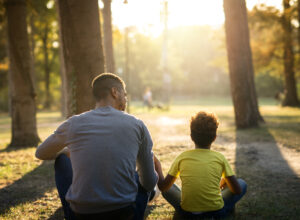
Pala Time at home isn’t a lecture or a reward chart. It’s a ritual you do together. Before school, when the morning is already fraying. After school, to wash off a hard day before it spills into the evening. At bedtime, when a wound-up body needs a bridge to sleep. You sit beside your child, you both find the pulse, and for one minute you breathe as a pair. No screens. No performance. Just two nervous systems settling in the same direction.
Something gentle happens in that minute that has nothing to do with the technology. A child who breathes with a parent learns, without a single word, that big feelings are survivable and that calm is something you can choose your way back to. You are not managing their emotions for them. You are handing them the tool, and showing them it works, by using it yourself.
Pala Time in the classroom
Teachers have known forever what the studies now confirm: a class cannot learn until it can settle. A room of thirty children carrying the leftover charge of the corridor, the playground, the argument at breakfast, is a room where nothing lands.
Pala Time at the start of a lesson is a reset the whole room can share. A single minute of breathing before the work begins. A threshold everyone crosses together, from out there to in here. The research on classroom breathing is encouraging precisely because it’s forgiving: the calming effect showed up across the group even when some children were only half in it. You don’t need every child to comply. You need the room to soften, and it does.
For a teacher, that’s not lost time. It’s the minute that makes the next forty usable.
An invitation, not another rule
We want to be careful here, because the last thing tired parents need is one more thing to police. Pala Time isn’t another limit to enforce or a stick to beat screen time with. Bonnie’s tablet in Toy Story 5 isn’t even the villain, the film is far wiser than that. Screens are part of our children’s world, and they will stay part of it.
The question is only whether presence gets a place in that world too. Whether, alongside all the time we spend pulled outward and lit up, there is a small, protected minute that pulls us back in.
That’s all Pala Time is. A minute you can feel. A skill your children will keep. A word, let’s Pala, that a family can grow up saying.
The screens aren’t going anywhere. Neither is the breath. We simply think it’s worth teaching our children, early and often and together, that they get to choose which one they turn to.
So put the tablet down for a minute. Find the rhythm. And Pala.
Pala is a screenless haptic band for presence and mental fitness. Join the waitlist at mypala.co.uk and be the first to bring Pala Time home.
Related reading
- The Screen Between You and Your Life
- The Most Expensive Thing You Own Is Your Attention
- Analog by Design
New here? Start with our guide: How to Be More Present in a Distracted World.